Tam Dao National Park Birding Site | Wildtour Vietnam
Summary
Tam Dao National Park is a convenient montane birding site close to Hanoi, with lowland evergreen forest on the lower slopes and cooler montane forest at higher elevations. Its accessibility makes it a useful first or final stop on a northern Vietnam birding circuit, particularly for species associated with hill forest and dense bamboo or scrub. The park also supports notable amphibian and plant diversity, reinforcing its importance as a northern mountain biodiversity refuge.
Birding specialities include Grey and Black-throated Laughingthrushes, Green and Purple Cochoas, Chestnut Bulbul, Coral-billed and Streak-breasted Scimitar Babblers and Short-tailed Parrotbill. The long-established Contour or Water Tank Trail remains one of the principal birding routes, while the Television Tower Trail and lower forest roads can produce additional montane species and winter visitors. Tam Dao town offers abundant accommodation and is roughly 60 km from Hanoi, allowing short visits of one or two days. Weekdays are preferable because popular walking routes can become crowded at weekends.
Click here to see the full bird checklist in Tam Dao
Most highlights
Grey Laughingthrush, Black-throated Laughingthrush, Green and Purple Cochoas, and Short-tailed Parrotbill
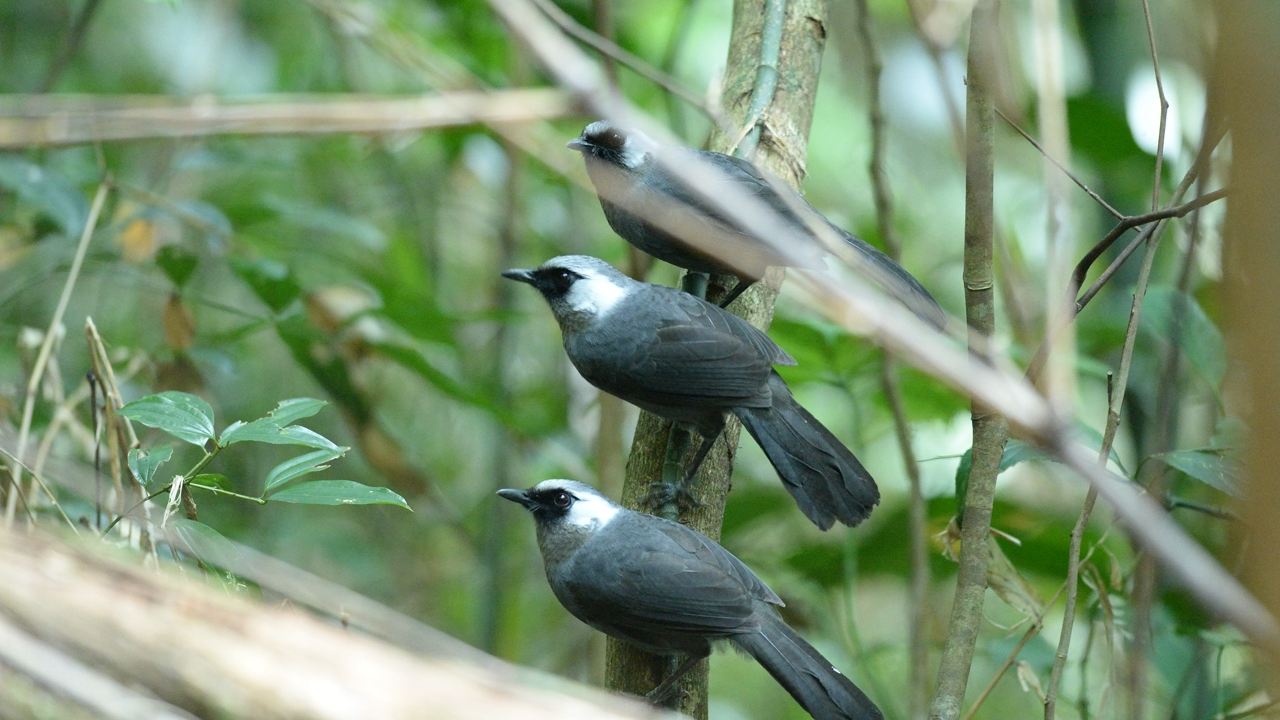
Grey Laughingthrush is one of the priority targets in Tam Dao National Park
Birding routes
The route from Tam Dao town, which lies within the national park, to Rung Rinh has long been the favoured birding route (known as the 'Contour Trail' or 'Water Tank Trail'). Short-tailed Parrotbill and Blue-naped Pitta can be seen along this route
Television Tower Trail: Walking up the 500 or so steps to the television tower above Tam Dao town, birders may encounter Grey Laughingthrush, Chestnut Bulbul, and, if they are fortunate, Green Cochoa. Be warned: this trail becomes very crowded with noisy students on weekends.
The route to Nung village from behind the park headquarters is a good walk through forest, which may yield Ratchet-tailed Treepie and Black-throated Laughingthrush. Note that permission is required from the national park to walk this route.
Other small trails around the foot of the mountain and along the road to Tam Dao town can turn up Spot-necked Babbler.
Transportation
Car or motorbike. About 60 km from Hanoi.
Accomodation
A famous tourist site, with numerous hotels, guesthouses, and restaurants
Relevant tour
- Tam Dao & Cuc Phuong Bird Photography Tour
- Fansipan Birding Expedition
- 2-4 Day Birding Tour from Hanoi
- 7-Day North Vietnam Birding Tour from Hanoi
More information about the birding sites in Vietnam
- Mang Den - Kon Plong Birding Site
- Da Lat Plateau Birding Site
- Cat Tien National Park Birding Site
- Yok Don National Park Birding Site
- Tam Dao National Park Birding Site
- Sa Pa - Fansipan Mt Birding Site
- Cuc Phuong National Park Birding Site
- Lo Xo Pass Birding Site
- Bach Ma National Park Birding Site
- Sa Mu & Bac Huong Hoa Birding Site
- Phong Nha - Ke Bang National Park Birding Site
- Tan Phu Forest (Thac Mai) Birding Site
- Can Gio Mangrove Biosphere Reserve Birding Site
- Mekong Delta Birding Site